
What a funded account really costs: carry the risk, or route it to the market
Challenge revenue is the easy part of a prop firm’s P&L. The hard part is what a funded account costs once the trader starts trading, and that turns on a single choice.
Challenge revenue forecasts well. You know your pricing, your volume and your pass rate. The hard part sits below the revenue line: what a funded account costs once the trader starts trading.
That cost comes down to one decision. The firm either carries funded-phase risk on its own book, or routes the account to the live market. Here is how each works, on the same account.
The funnel both models start from
The front of the funnel is the same either way. In the largest published dataset — FPFX Technology data on about 100,000 traders across 10 firms (Finance Magnates, 2024) — 14% of traders passed a challenge and were funded, and fewer than half of those were ever paid. That is about 7% of everyone who bought a challenge. Firms that publish their own figures land in the same range: Topstep reported that 33.3% of funded participants were paid in 2025.
Payouts also arrive late, weeks to months after the fees meant to cover them. FundedNext reported a median of 28 days from funding to first payout request on its CFD accounts, with a tail past 90 days.
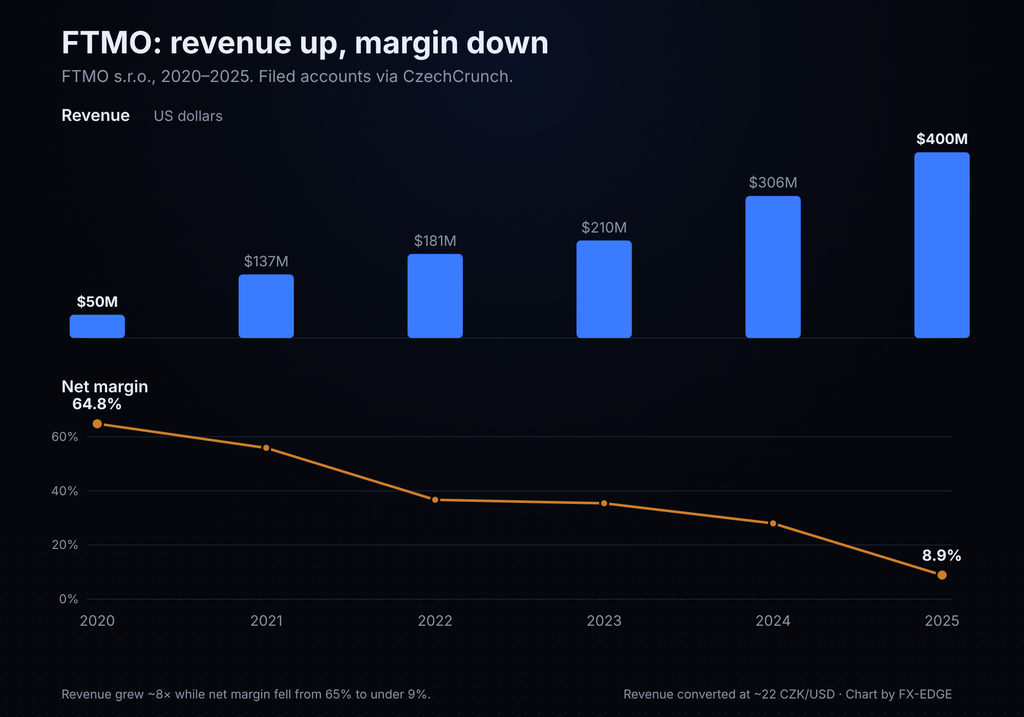
Where the two models part company is the payout ratio: total payouts over revenue. FTMO is the clearest case. Its revenue grew about eightfold between 2020 and 2025, while its net margin fell from 65% to under 9%. TradeInformer’s reading of its 2024 accounts put payouts at roughly 55% of revenue, and rewards tied to 2024 came in 82% over reserve, with net profit down 59% on a year when revenue rose 31%. A firm that size can absorb a year like that. A smaller one has far less room.
Carrying the risk yourself
Carry the risk, and a funded account is virtual. When the trader loses, no money moves: the firm keeps the challenge fee and the account closes. When the trader wins, the firm pays their share of the profit out of its own cash.
So the cost is one-sided. The best case is $0, when the trader breaches and nothing is paid. The worst case is open-ended, because the payout grows with whatever the trader makes, with no ceiling. Around that sit the costs that are easy to underestimate: a payout reserve that grows with the book and can still fall short, as FTMO’s did; a cashflow lag, since payouts land months after the fees; and tail risk, because a run of winners in a volatile month pushes payouts far past forecast, all at once.
Routing to the market
Route the account instead, and the positions are real, so money moves both ways. With Real Market Liquidity, the firm sends the funded accounts it chooses to the live market through a single hedge account at FX-EDGE.
When a routed trader wins, the profit lands on the hedge account as real balance, and the payout is paid from there, rather than from challenge revenue or a reserve. When a routed trader loses, the loss comes off the hedge balance, but the firm’s own rules close the account at its drawdown limit. So the loss on any one routed account is capped at that limit.
The firm funds the hedge account at a level it chooses, and FX-EDGE matches the deposit 1:1 in credit, so the book runs on less of the firm’s own cash. There is no per-account fee. A revenue share on the routed P&L is possible, agreed case by case.
One account, two models
Take a $25,000 account, a 10% maximum drawdown and an 80/20 split. The figures below are the firm’s profit or loss on that account under each model.
| Trader’s return on the account | Carry the risk | Route to market |
|---|---|---|
| Breaches at max drawdown | $0 | –$2,500 (capped) |
| Makes 10% | –$2,000 | +$500 |
| Makes 20% | –$4,000 | +$1,000 |
The percentages are the trader’s return on the account: a 10% return is a $2,500 profit, a 20% return is $5,000. The split stays 80/20 on every row; what changes down the rows is how well the trader does.
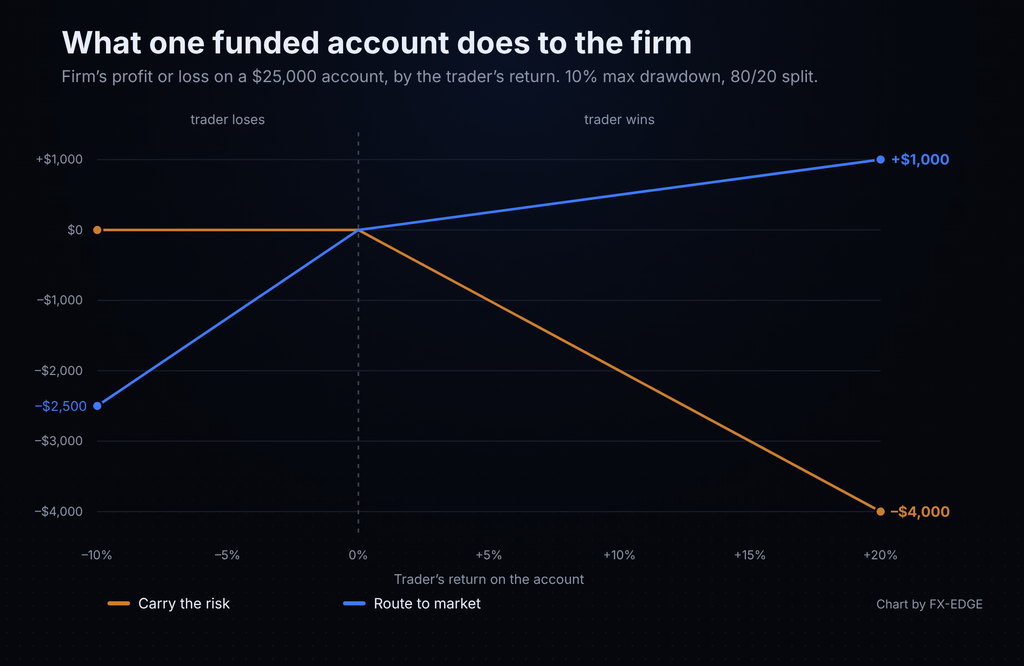
Firm’s profit or loss on one $25,000 account, by the trader’s return. Carrying the risk, the best case is zero and the downside has no floor; routing, the worst case is set before the first trade and the result improves the better the trader does.
Read the two columns together. When the trader wins, routing turns their profit into your income: the gain lands on the hedge as real cash, you release the trader’s share and keep yours. Carrying the risk, the same win is a bill, because the trader’s share comes out of your own pocket. When the trader breaches, it reverses: carrying the risk costs nothing, while a routed account takes the loss, capped at the drawdown limit.
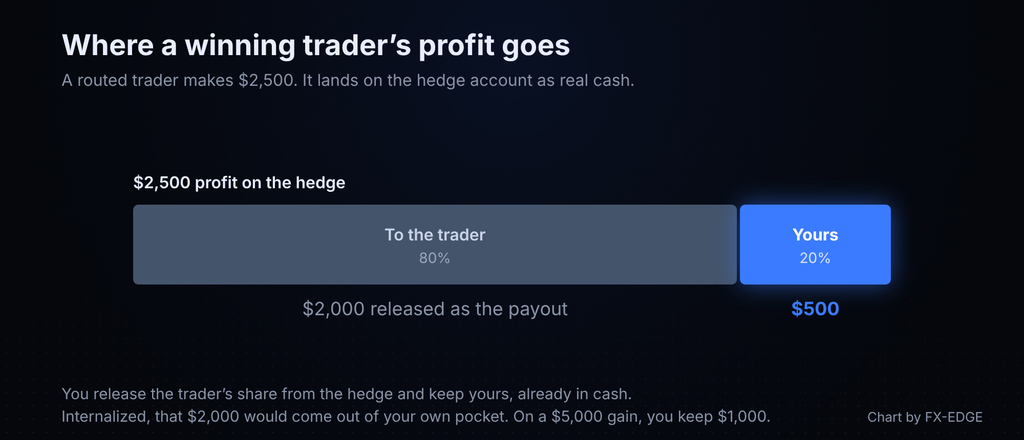
It comes down to one rule: routing an account moves the firm’s result by exactly that trader’s P&L. Carry the risk and you are on the opposite side of your traders. Route them and you are on the same side.
Neither is free. The cap on a routed loser is paid for with the losses you would have kept on a virtual book. That is why a firm routes the flow it expects to profit and keeps the rest on its own book. Most funded traders breach, so routing the whole book would usually cost more than holding it, and the firm’s profit on those breachers is the challenge fee, which both models keep.
What changes at scale
Across a book, the difference compounds. Carrying the risk needs a payout reserve with no fixed ceiling. Routing needs a hedge deposit against a worst case that does have one: the drawdown limits added up, a number you can size before the month starts. A strong month for traders drains the reserve under one model and adds to the hedge balance under the other.
Either way, your rules stay yours. Drawdown limits, breaches and payouts run on your own platform, while FX-EDGE services the hedge account and its single margin level.
The choice
The cost of a funded account is not a single number under either model. Carry the risk, and it is zero or an open-ended payout. Route it, and it is a loss capped at the drawdown limit, or a share of a profit the market has already paid. The question is not which is cheaper in a good month. It is which cost line you want to be holding in a bad one.
FAQ
What does a funded account cost a prop firm?
It depends on the model. Carrying the risk, a funded account costs nothing when the trader breaches and an open-ended payout when the trader wins, plus the reserves held against those payouts. Routing it to the live market, the loss is capped at the account’s maximum drawdown, and a winning trader’s payout is funded by the profit on the hedge account.
How is the loss on a routed account capped?
The firm’s own drawdown rules close the account when it hits its limit, so the loss on the hedge account is limited to the account balance times the maximum drawdown — $2,500 on a $25,000 account with a 10% limit. In a fast market, slippage through the stop can add to that.
Where do payouts come from when an account is routed?
From the hedge account. A routed trader’s profit lands there as real balance; the firm releases the trader’s share and keeps its own. The payout does not come out of challenge revenue or a reserve.
Is routing always cheaper than carrying the risk?
No. Routing moves the firm’s result on each account by exactly that trader’s P&L. On a losing account the firm pays real money it would have kept; on a winning account it keeps what it would have paid out. Most funded traders breach, so a firm routes the flow it expects to profit and keeps the rest on its own book.