
The Prop Firm Business Model Explained: Distribution, Not Trading
Prop firm founders still introduce their business like it’s part of the trading world: risk management, funded accounts, performance evaluation. While it may make sense from a marketing perspective, that description is no longer the operating truth.
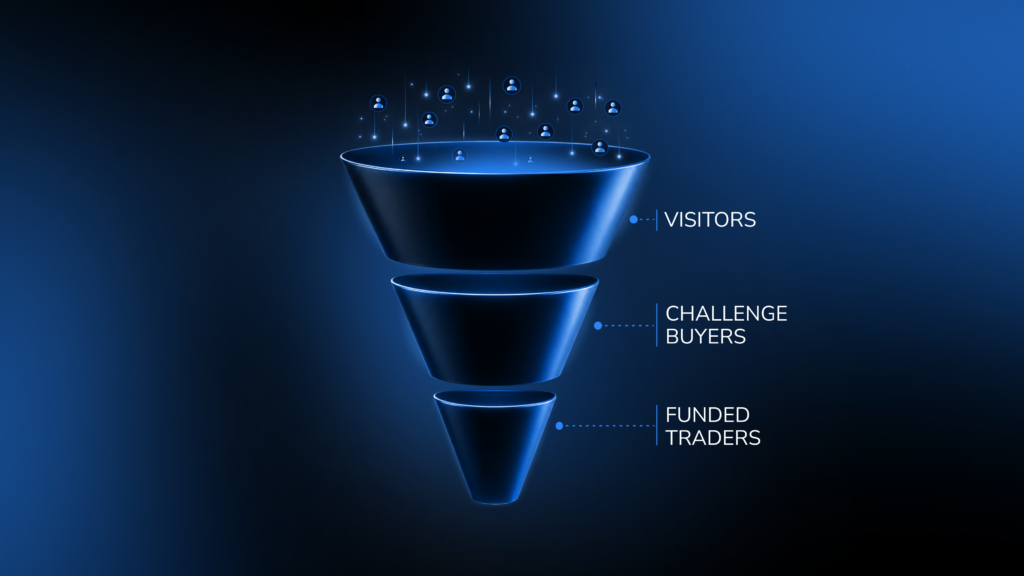
A modern prop firm’s revenue isn’t generated by trading. It comes from selling challenges to retail traders seeking access to funded capital. The challenge is the product. Marketing creates demand and conversion turns that demand into revenue. Trading occurs later, downstream of the actual business – and under the right structure, it doesn’t happen on the firm’s balance sheet at all.
That’s the central reframing. Once funded-phase risk is fully transferred to a liquidity provider, what remains isn’t a trading company. It’s a marketing and acquisition operation sitting on top of a liquidity stack: a distribution business.
This distinction isn’t semantic. The reclassification changes what founders should optimize, who to compete against, and what the company is worth to an outside acquirer. Founders who recognize this early will build on a different operating system than those who don’t.
What a Prop Firm Actually Does
If you reduce the model to its functional components, the center of gravity is simple: a prop firm acquires retail traders through paid media, organic content, affiliate networks, and community. It converts that traffic into paying customers by selling them a challenge – typically a few hundred dollars for a $25,000 to $200,000 funded account. Roughly 14% of challenge purchasers pass and become funded, and around 7% ultimately receive a payout.
Everything after the challenge purchase is fulfillment. The trader trades while the firm either retains the resulting risk on its own book (internalization) or it doesn’t.
That post-purchase layer causes prop firms to be mistaken for trading companies. It creates trading-style outputs: a P&L that shows gains and losses, reserve behavior that resembles a hedge fund, or a risk team that looks like a buy-side risk team. That’s why it’s easy for founders, investors, and analysts to conclude they’re looking at a trading firm.
Revenue generation occurs in acquisition, whereas risk is formed in fulfillment. They are two completely different businesses bolted together by historical accident.
Why the Trading-Company Frame Is Legacy
Internalization emerged as the original model because, early in the industry’s development, there was no mature infrastructure to transfer funded-phase risk at a predictable cost. Firms held the risk because they had no alternative, and trading P&L became a built-in component of the business.
That constraint has materially changed. Full funded-phase risk transfer at a fixed fee, enabled by FX-EDGE – starting from 2% of the funded account balance (4.5% in a representative scenario) – turns the largest variable in a prop firm’s P&L into a discrete, predictable line item. Industry data suggests that even the largest firm operating today runs a 55% payout ratio, with a buffer of roughly 30 percentage points before payouts consume the full margin.
Trading P&L here isn’t proprietary alpha. It’s the residual of a funnel that, by design, selects for traders who can trade. Holding it is a choice – and that choice has costs.
When risk transfers out, the trading P&L loses its foundation. What remains is the funnel.
What Changes When You Accept the Reframe
Adopting the reframe produces immediate changes in priorities, decision-making, and how the business is assessed.
What you optimize for
A trading company optimizes for risk-adjusted return on its book, while a distribution business is managed around cost of acquisition, lifetime value, conversion rate, and retention. The metric set isn’t similar – it mirrors the metrics of any digital business selling a paid product to retail customers. Under this model, funded-phase profitability is no longer a strategic variable, but a vendor cost.
Who you compete with
Other prop firms are the obvious competitors, but they are neither the only ones nor necessarily the most important. The relevant competition includes any product that attracts the same discretionary spending and the same user attention from retail traders: sports betting, crypto exchanges, copy-trading platforms, and retail brokers using aggressive incentives. Wallet, attention, and advertising inventory are shared constraints. The firms that win over the next five years will position themselves as competing for retail attention, not merely for trader selection.
How you’re valued
Trading companies are commonly valued on earnings multiples, discounted for tail risk. A distribution business with predictable unit economics is valued on revenue multiples, recurring-revenue multiples, or – at scale – consumer fintech multiples. The same revenue stream can command a materially higher valuation under a distribution framing. This directly affects how acquirers, lenders, and growth investors underwrite the business. Founders who can present a clean distribution P&L typically raise on better terms.
What kind of company you build
A trading company concentrates resources in risk, quant, execution, surveillance, and operational control. A distribution business hires growth marketers, content and brand teams, community and partnerships, and creator relations. These are different hiring profiles, different management systems, and different incentive structures. Founders attempting to build a distribution organization while operating a trading-first structure create an internal contradiction that is difficult to resolve.
What This Means for Founders
Over the next 24 months, the firms that scale meaningfully will not be those with the most elaborate challenge mechanics or the most aggressive payout splits. The advantage will accrue to teams that accurately recognize – earlier than their competitors – that they were never running a trading business in the first place.
Many founders already sense this. It shows up as a desire to invest more in brand, unease at how much of the organization is dedicated to risk operations rather than growth, and frustration that funded‑phase volatility makes it impossible to invest confidently in the parts of the business that actually compound. These are not isolated problems – they reflect a mismatch between the operating model and the primary value driver.
The reframe resolves that tension: a prop firm with transferred risk is a distribution business. It should be staffed, capitalized, marketed, and valued accordingly. Everything else is a legacy of an industry structure built for a different era.
Industries tend to be repriced when they are evaluated under a different classification. This is a classification change.